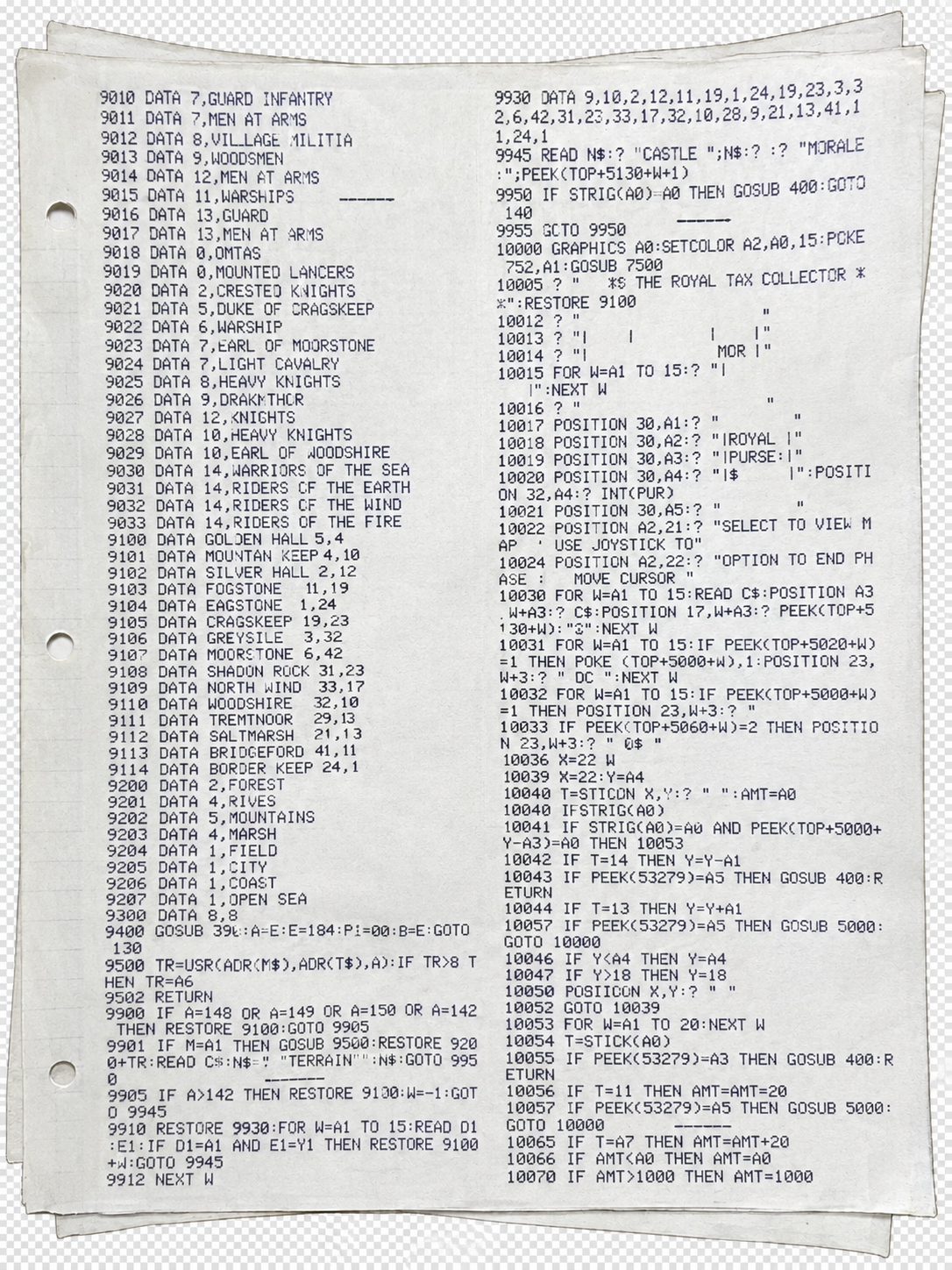
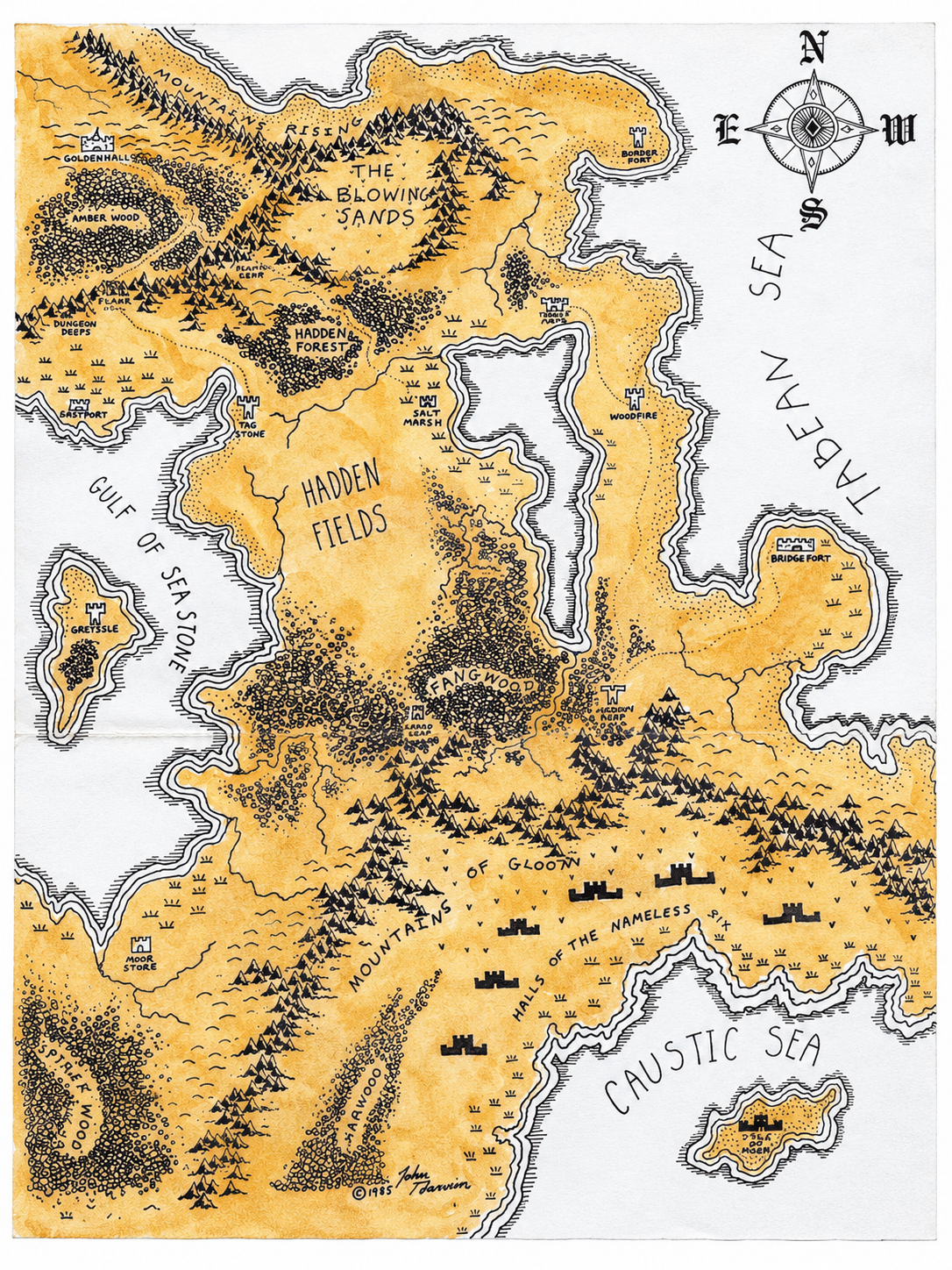
In 1985, I was teaching myself to program on an Atari 800. This was a time when you could sit down with a BASIC manual, a keyboard, and an idea, and attempt to build an entire world yourself. I loved tabletop miniatures, RPG games, fantasy worlds, and the challenge of creating a game on the computer.
Decades later, I found a box of my old papers. Inside were pages of numbered Atari BASIC, printed on an old dot-matrix printer, and a hand-drawn map that I'd done in 1985. All the hardware I'd used to write and run the program - the old Atari console, the 8k memory cartridge, the portable floppy drive - were long gone. It was like unearthing a fossil, a remnant of something that once lived, but was now long gone. Could I breathe new life into it?
The short answer is: no. I was able to feed the listings into GPT and get an accurate transcript, but there was too much missing. While the AI understands Atari BASIC, including all of the specialized hardware calls for things like disc access and joystick inputs, key disc-based data was missing. Also, my brother had written a few machine-language subroutines for scrolling and manipulating the large map, accessed in BASIC via the USR command. These commands were, to me, black magic, and just as inaccessible.
While I would not be turning these old pages into a working game, I could use the AI to reconstruct a surprising amount of the original. The code had all the references and data for the tactical and strategic maps; combat concepts such as COLUMN, LINE, SKIRMISH, CHARGE, and HOLD AND DEFEND were there; as were terrain types, castles, armies, and gameplay systems involving movement, combat, morale, taxation, and resupply.
So I had all the systems, but none of the data, which had all been stored on floppy discs, or USR commands, which allowed us to manipulate the data quickly. Without those, I had no game.
Still, GPT could at least give me an idea of what that game had been. It rebuilt a fifty-by-forty-six-character strategic map using the geography of my surviving hand-drawn fantasy map, then brought back systems inspired by the BASIC listing: armies, castles, formations, battle orders, a royal treasury, taxes, resupply, morale, and turn-based combat.
For me, the interesting part is how the game showed a continuity in my creative thinking. In the 1980s, I was trying to create an interactive fantasy world with the tools I had. Forty years later, I was using GPT to investigate that same world, decipher its rules, and rebuild it for a browser. The technology had changed almost beyond recognition, but the impulse was exactly the same.
The original BASIC listing still matters more to me than a polished remake. It documents how I thought about games in 1985: the names I invented, the systems I wanted, and the limits I was trying to push against. It's amazing that a few sheets of paper could become the starting point for a playable game again. The Battle of Hadden Fields is both a look back at where I began and another example of why I still love making worlds.